HMNZS Manawanui | 07 Risk list
A risk list for a ship's bridge
Introduction
The Court of Inquiry presents its findings as text. The report makes little use of the structured methods available for organising this kind of material. That is not a criticism — final reports usually take this form, and it is reasonable to assume that more formal analysis was carried out during the investigation and simply not published. We cannot know.
What follows is an attempt to take the Court’s findings and run them through a risk process of the kind used routinely in medical devices. The method is straightforward: identify the hazard, describe the foreseeable sequence of events that turns it into a hazardous situation, estimate the severity of the resulting harm, and from that derive risk controls.
Controls are listed in order of priority — inherent safety by design first, protective measures second, information and training last — because that is the order in which they actually work. The first three groups are the designer’s and are ranked by strength, as ISO 14971 requires. The last three belong to the operating organisation and do not sit on the same ladder: a drilled response is not weaker than a warning label. Scheduled frame checks do not guarantee that anyone notices; they create an occasion for noticing.
The exercise is worth doing because of what it produces. Thirteen hazards yield nearly eighty distinct controls. That is the point of the analysis — not that the Navy failed to think of them, but that a structured method generates them systematically rather than leaving them to be recalled.
Generating a control is the easy part. A control is only worth anything if it can actually be deployed — in the organisation, in the people, and in the materiel. Future posts will work through where these might realistically be implemented, and what it would cost to do so.
This is an illustration, not a risk file, and not an assessment of what the Royal New Zealand Navy did or should have done.
The list
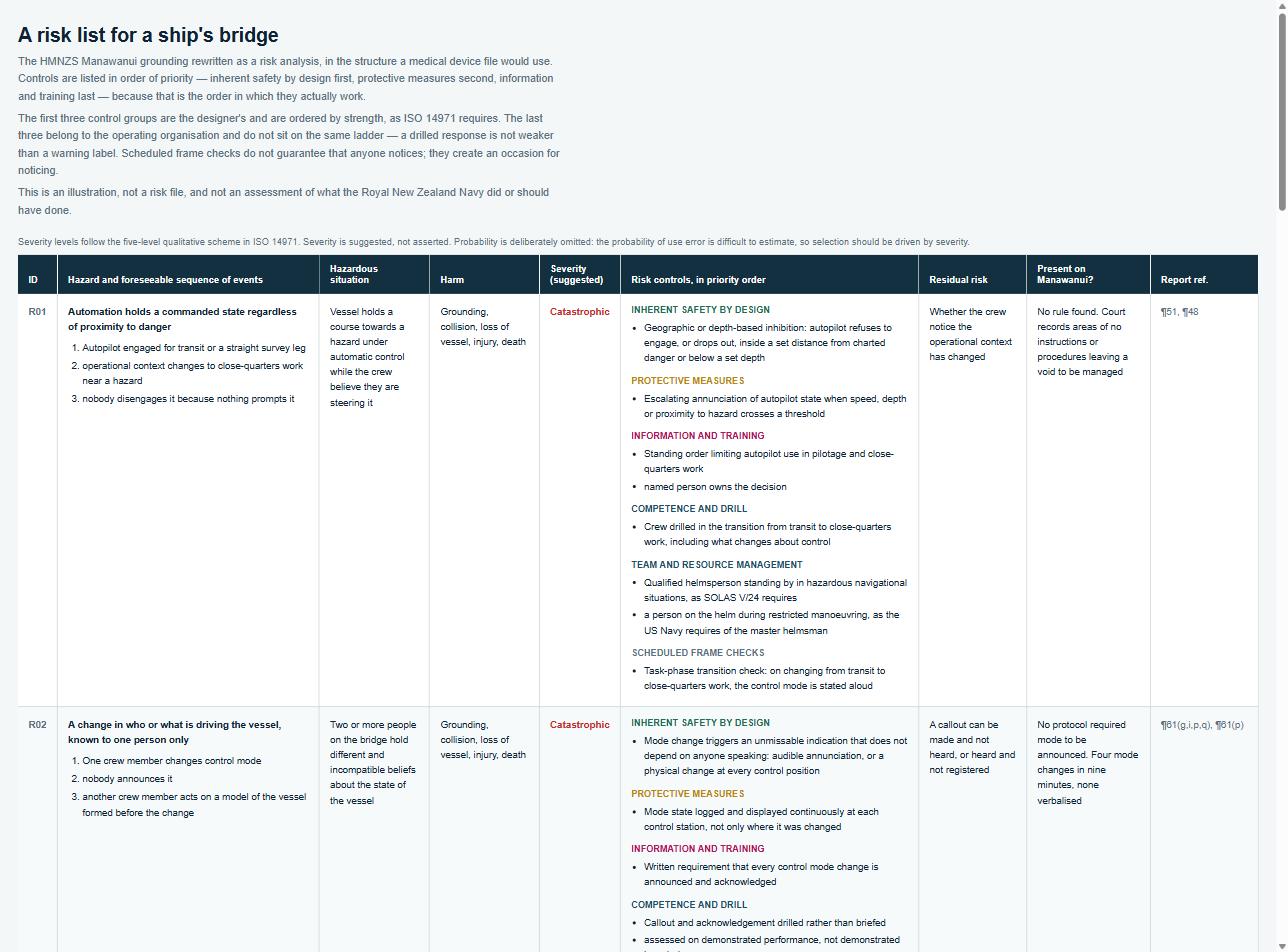
Thirteen hazards from the grounding, each with its controls ranked by strength and a column recording which were present on the night.
Author’s own work, derived from the Court of Inquiry final report, 31 March 2025. Enlarge the list to read it in full — it is wider than this column.
Severity levels follow the five-level qualitative scheme in ISO 14971. Severity is suggested, not asserted. Probability is deliberately omitted: the probability of use error is difficult to estimate, so selection should be driven by severity.
Derived from the Court of Inquiry into the loss of HMNZS Manawanui, final report dated 31 March 2025. Structure follows the risk control priority in ISO 14971. Not a comment on the court martial proceedings arising from the loss.
About
YachtPrep Team
YachtPrep Team is a passionate developer and boating enthusiast with years of experience in web development and maritime activities. They love sharing knowledge and helping others navigate the waters of both coding and boating.