HMNZS Manawanui | 01 Loss
The loss of HMNZS Manawanui
Introduction
The Court of Inquiry into the loss of HMNZS Manawanui found that the ship grounded because of human error. That is true and it is not very useful. What the report also contains, buried in a minute-by-minute reconstruction from the voyage data recorder, is something more specific and more uncomfortable: a working control system, a trained crew, a correct procedure they had been taught, and thirteen minutes in which none of it mattered.
The five sections below follow the ship’s track. Each corresponds to a stage of the map.
Not a gender or sexual orientation issue
The commanding officer has been attacked over her gender and her sexual orientation, and some of the coverage has ridiculed her as a diversity hire. This analysis rejects that framing. Nothing in the Court of Inquiry’s findings turns on either, and reporting of that kind is click bait we do not entertain.
What follows is an attempt to establish what actually caused the loss: the control modes, the diagnosis the bridge adopted, the interface that supported it, and the decisions taken above the bridge long before that evening.
One caveat, stated plainly so it cannot be read as evasion. There are real psychological and physical differences between the sexes, and if any of them were relevant to what happened here this analysis would raise them. On the evidence in the report, none is. There is nothing to suggest gender or sexual orientation was a contributing factor.
A risk analysis always has to review the actors involved, and if we do find evidence we will publish our opinion. At this time we do not find evidence.
The AcciMap
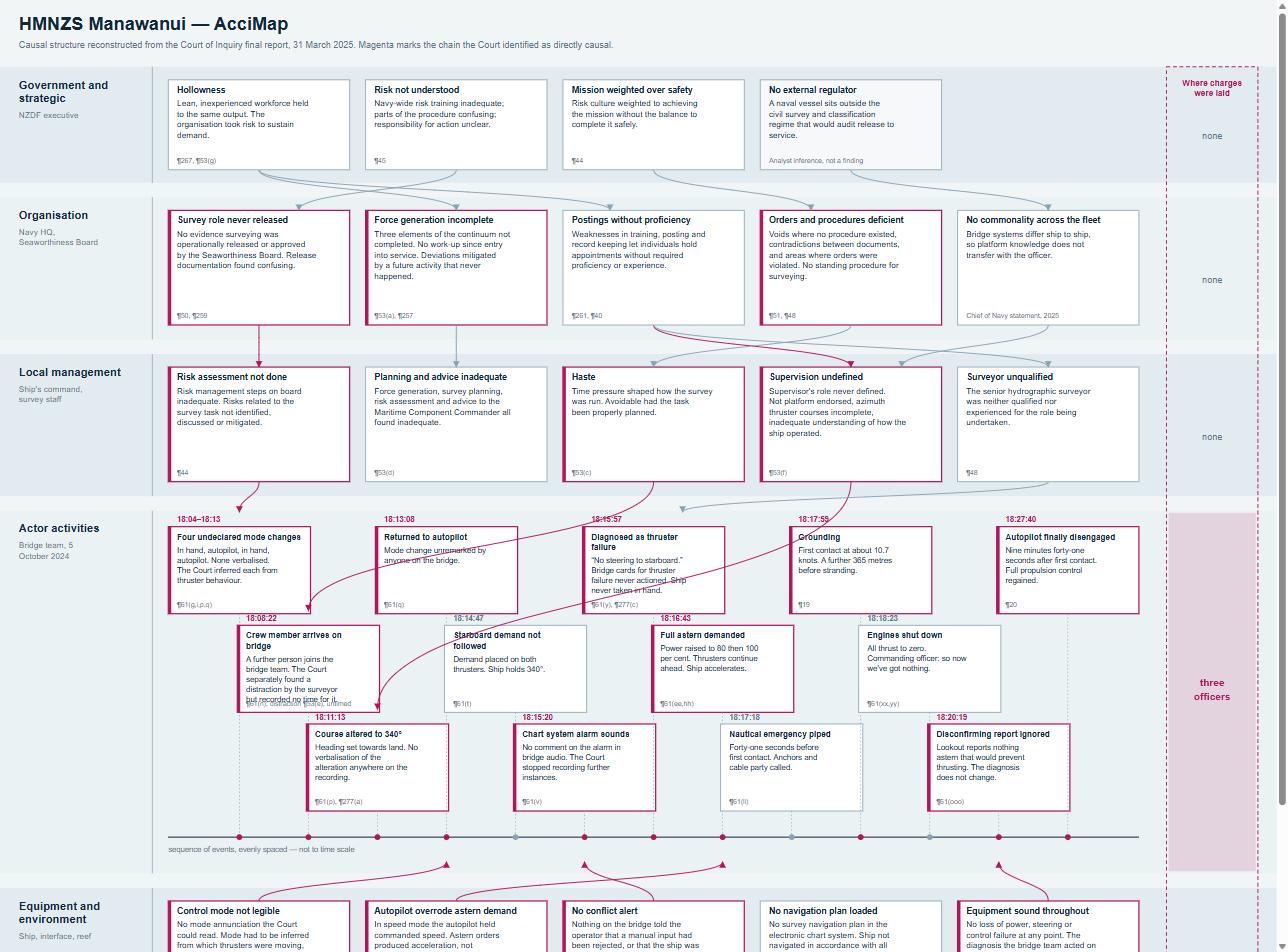
The diagram below reconstructs the causal structure from the report, from government and strategic level down to the equipment and the reef. The magenta path is the chain the Court identified as directly causal. Paragraph numbers refer to the final report; one node is marked as analyst inference rather than a finding of the Court.
Author’s own work. Times and findings from the Court of Inquiry into the loss of HMNZS Manawanui, final report 31 March 2025.
Sequence of events
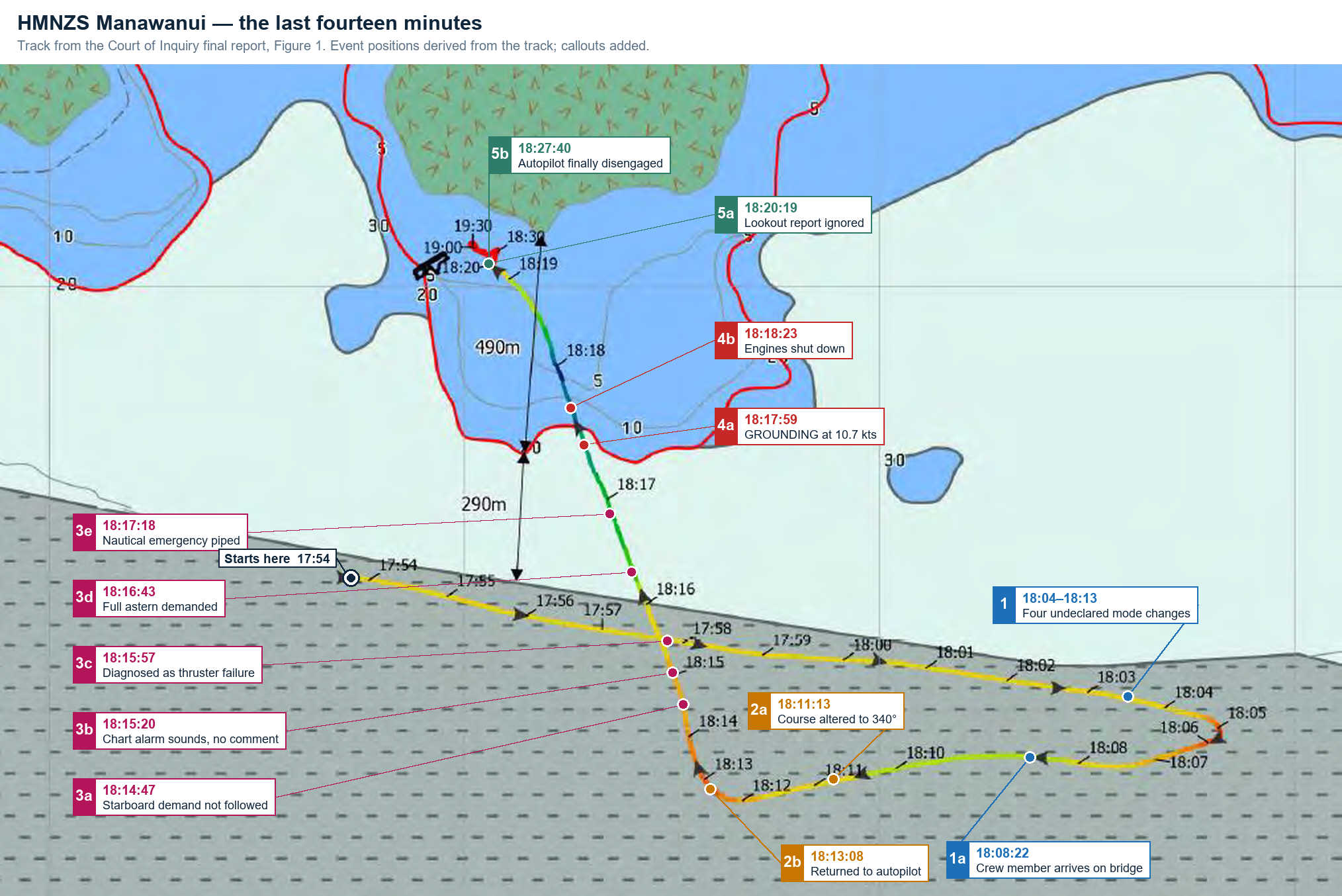
Figure 1, track reconstruction, from the Court of Inquiry into the loss of HMNZS Manawanui, final report 31 March 2025. © New Zealand Defence Force, Crown copyright. Reproduced for commentary and criticism. Annotation added by the author.
Author’s own work. Times and findings from the Court of Inquiry into the loss of HMNZS Manawanui, final report 31 March 2025.
Author’s own work. Times and findings from the Court of Inquiry into the loss of HMNZS Manawanui, final report 31 March 2025.
Turn by turn analysis
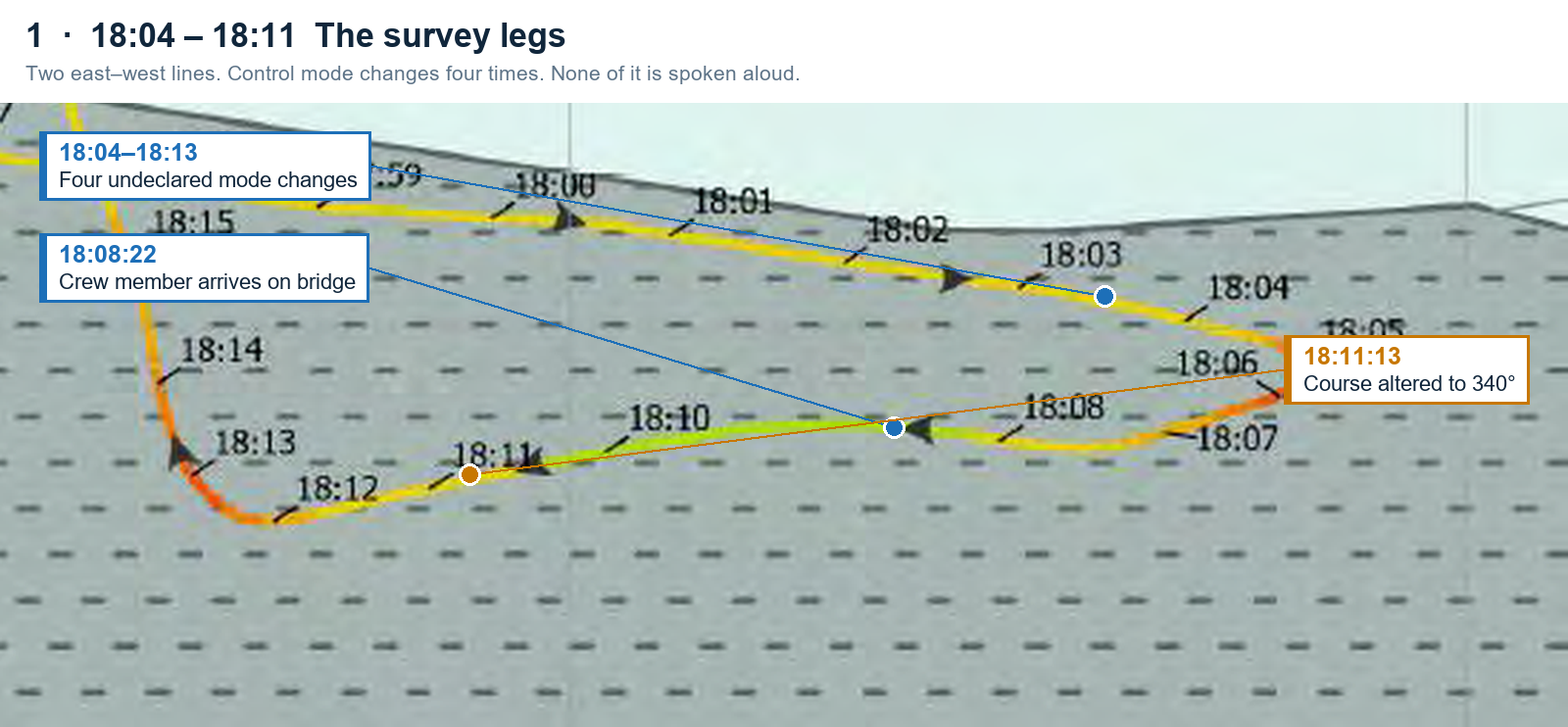
118:04 – 18:13, the survey legs
The ship is running hydrographic survey lines south of Upolu: two long east-west legs, a turn at each end, sonar logging on the straights and off through the turns. Routine work, done close to a reef because that is where the survey is.
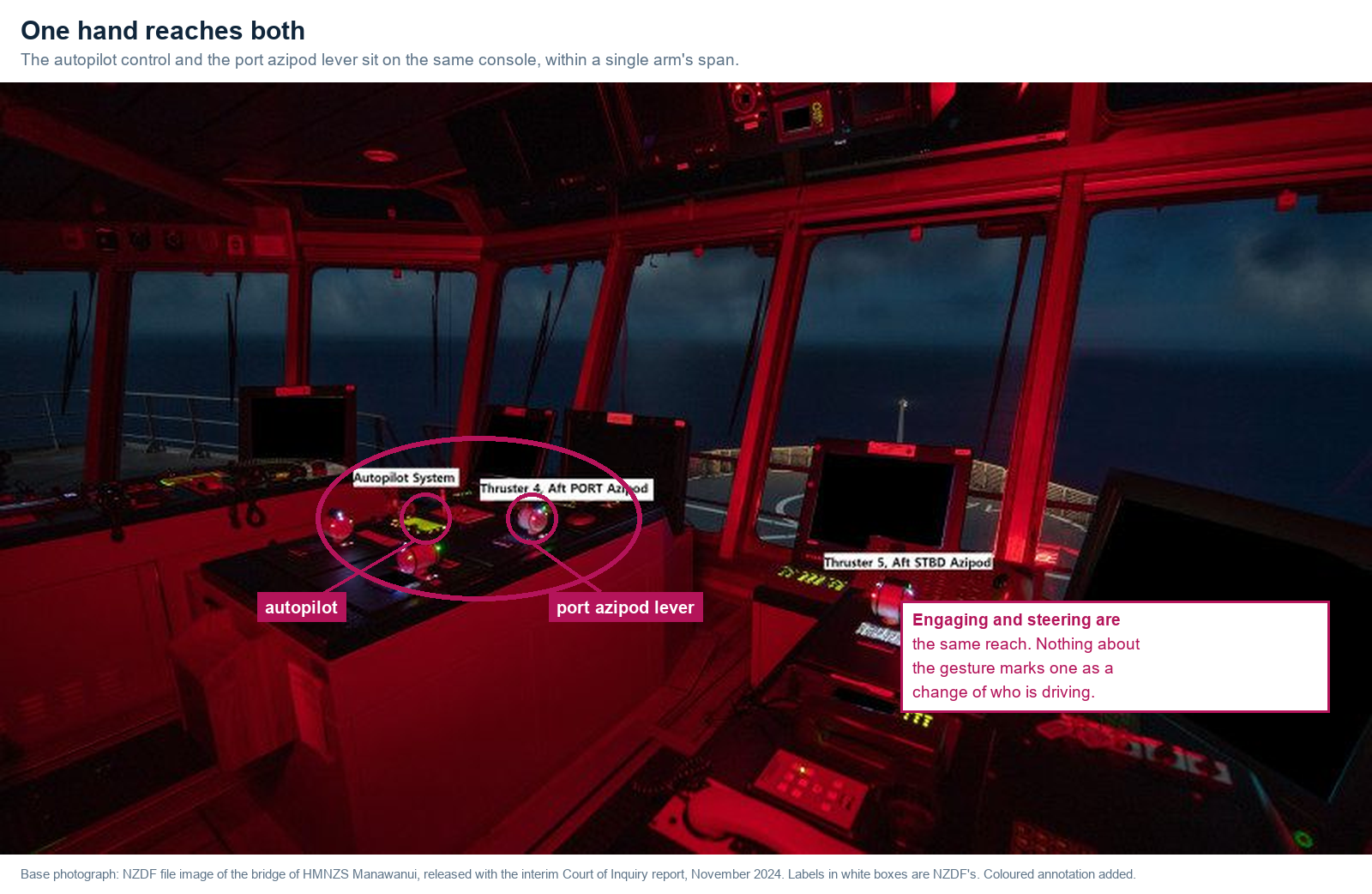 The helm controls. NZDF file image, annotation added — click to enlarge.
Manawanui has no wheel. She is driven by two azimuth thrusters, pods that rotate to point their thrust in any direction, worked from a control panel. The same hardware serves manual steering, autopilot and dynamic positioning. What changes between them is not the controls but who is holding them: the operator, or the autopilot.
In these nine minutes the ship changes control mode four times. In hand at 18:04:10, autopilot at 18:06:20, in hand at 18:11:13, autopilot at 18:13:08.
None of it is announced. The Court states explicitly that the 18:11:13 course alteration has no verbalisation anywhere on the recording, and its narrative, which faithfully captures routine exchanges like “check port quarter” and “start logging”, records no announcement of any mode change either.
There is a second, larger problem with those four changes. The voyage data recorder did not log control mode at all. The Court could not read the ship’s mode from the recorded evidence. It had to deduce each change from thruster behaviour, using expert testimony that in autopilot the starboard pod dominates while the port pod sits fore and aft, whereas in hand both respond together.
A formal board of inquiry, with the complete data set, unlimited time and a naval expert to interpret it, could only establish what mode the ship was in by inference from secondary effects. It is worth pausing on what that implies about what the display was telling anyone glancing at it.
218:11 – 18:15, the turn north
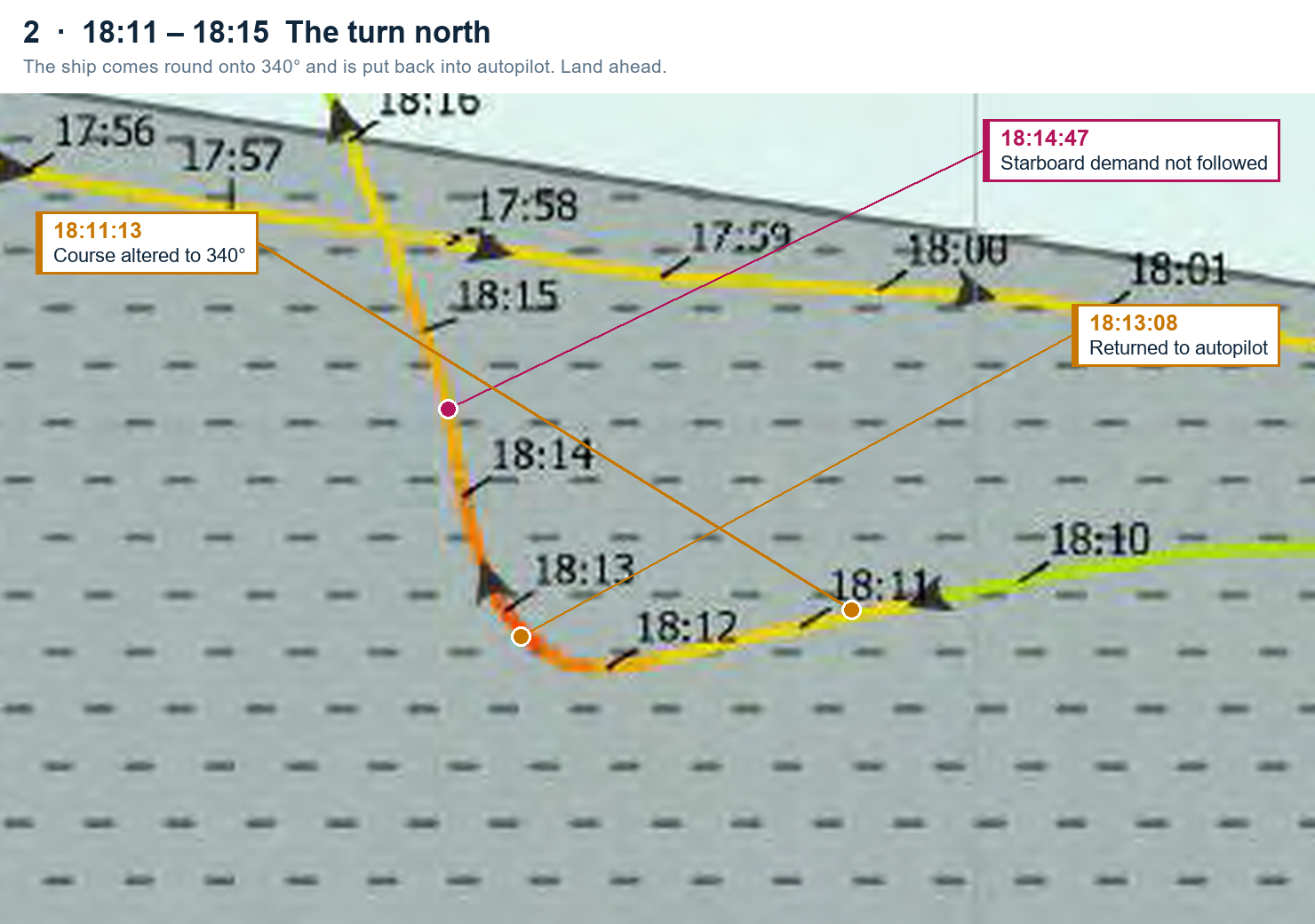
At 18:11:13 the ship alters course to 340 degrees, towards land. The turn is made with the ship in hand, and it works: the Court’s evidence for the mode is that demand was placed on both thrusters and both responded.
This is the thing that confuses most readers of the report. The crew turned the ship successfully at the eastern end of the survey area at around 18:05, and turned it successfully again onto 340 at 18:11, and then a few minutes later could not turn it at all. Nothing broke in between. Every manoeuvre that worked was made with the ship in hand. Every input that failed was made in autopilot.
At 18:13:08 the ship is put back into autopilot, now steadied on a heading towards the reef.
The report does not say who did this, or why. Not because the Court was incurious, but because there is nothing in the record to attribute it to anyone. If the mode is not logged and the change is not spoken, no evidence connects the action to a person. The passage where the Court weighs competing accounts of causation, paragraphs 83 and 84, is redacted from the public version.
The bridge layout diagram published with the report explains how this can happen without anyone concealing anything. There are two sets of azimuth thruster controls, one on the dynamic positioning desk and one on the adjacent console. There is one autopilot switch, and it sits on the DP desk immediately beside that desk’s thruster controls, close enough to reach both without moving. The officer of the watch stands between the two.
So one person can engage the autopilot and work the thrusters with the same hand. Anyone at the second console has thruster controls with no autopilot switch beside them at all. The act of engaging and the act of steering are separated by seconds and by nothing else.
For ninety-nine seconds nothing happens. The ship holds 340, nobody asks a question, and there is no reason to. The error has been made and it is not yet costing anything.
318:15 – 18:18, the run in
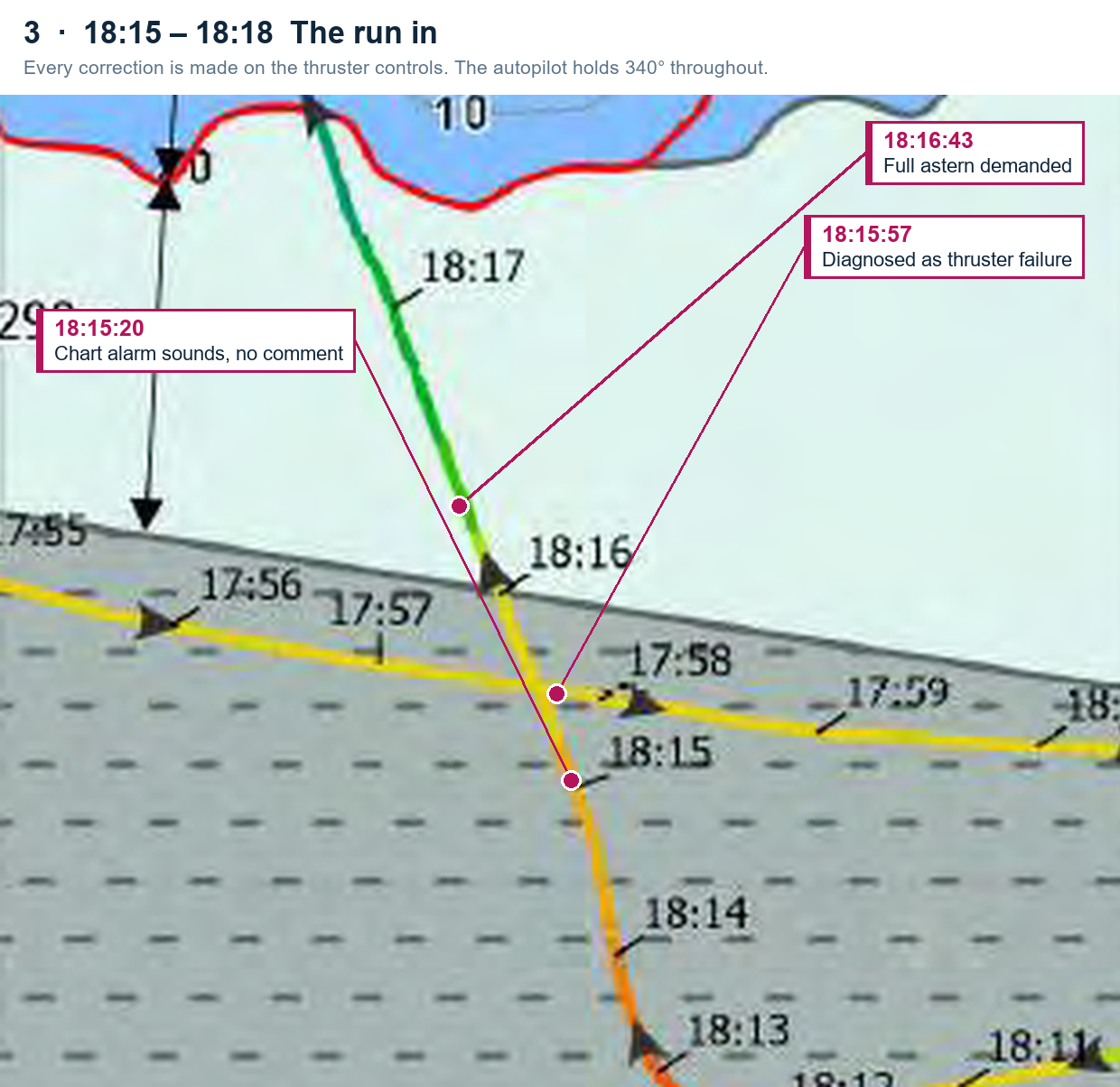
At 18:14:47 demand is placed on both thrusters to come to starboard. The thrusters do not follow. The ship holds 340.
This is the moment the error becomes visible, and it is the beginning of the only window in which the accident was straightforwardly recoverable. For seventy seconds the fault is evident and no explanation has yet been adopted.
At 18:15:20 the chart system alarm begins sounding. There is no comment on it in the bridge audio. The Court adds a line that says more than it intends: no further instances of the alarm will be noted in this narrative. There were too many alarms to be worth recording.
At 18:15:57 the officer of the watch says “no steering to starboard”, and the window closes. That sentence is a diagnosis. From it follows a thruster control failure, and from that follows everything else.
The bridge cards for thruster failure required the ship to be taken in hand first. That step was never carried out. It would have worked.
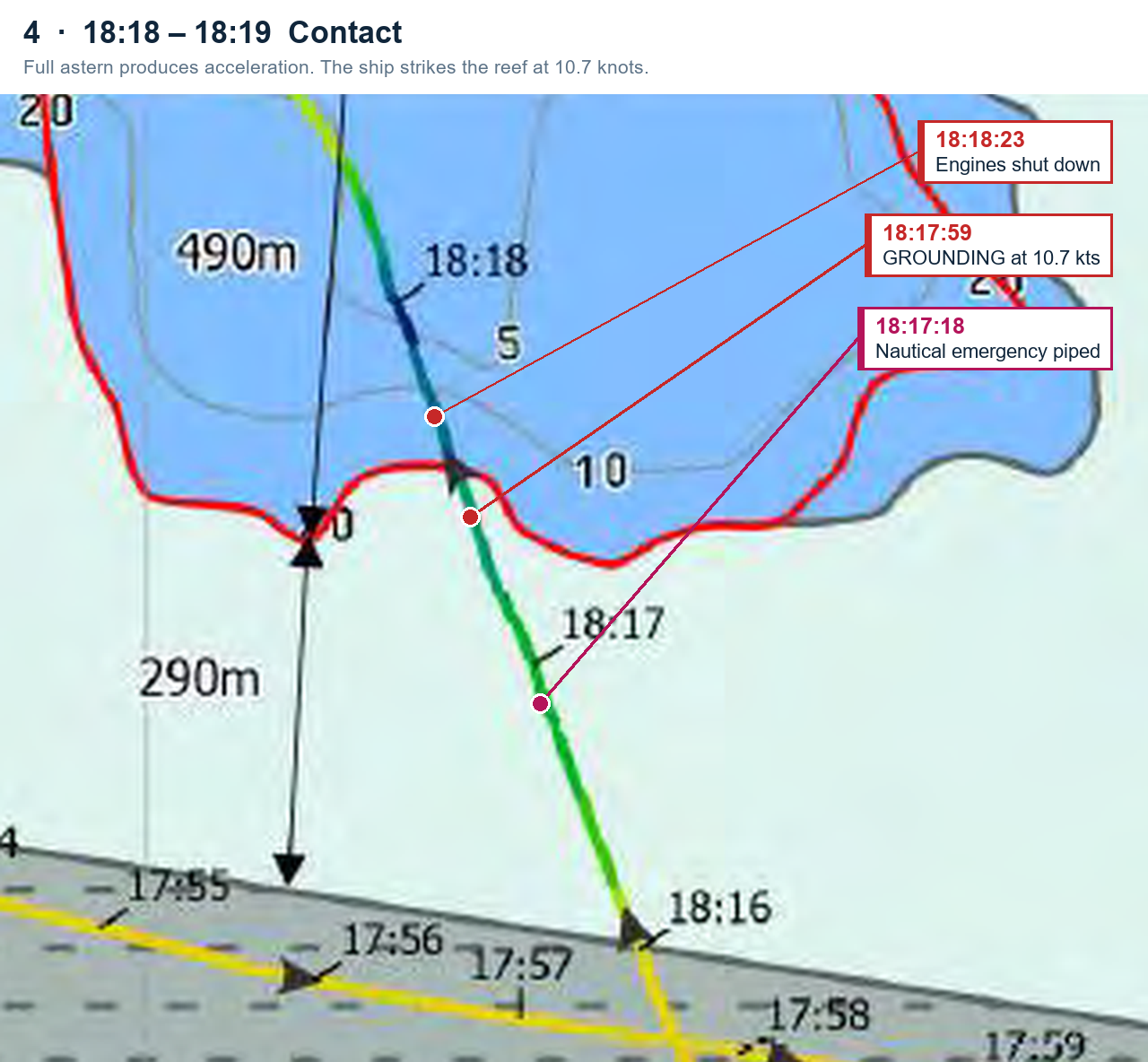
Instead, at 18:16:43 the thrusters are ordered astern and power raised to eighty per cent, then to one hundred. The autopilot is in speed mode. It is holding a commanded speed, and it reads the astern demand as something to overcome. The ship accelerates. At 18:17:53 the officer of the watch reports ten knots increasing under full astern.
That is the sharpest thing in the whole report. The interface allowed a man trying to stop his ship to drive it faster into the reef, and gave him no signal that this was what he was doing.
418:17:59 – 18:19:30, contact
First contact at 18:17:59, at about 10.7 knots.
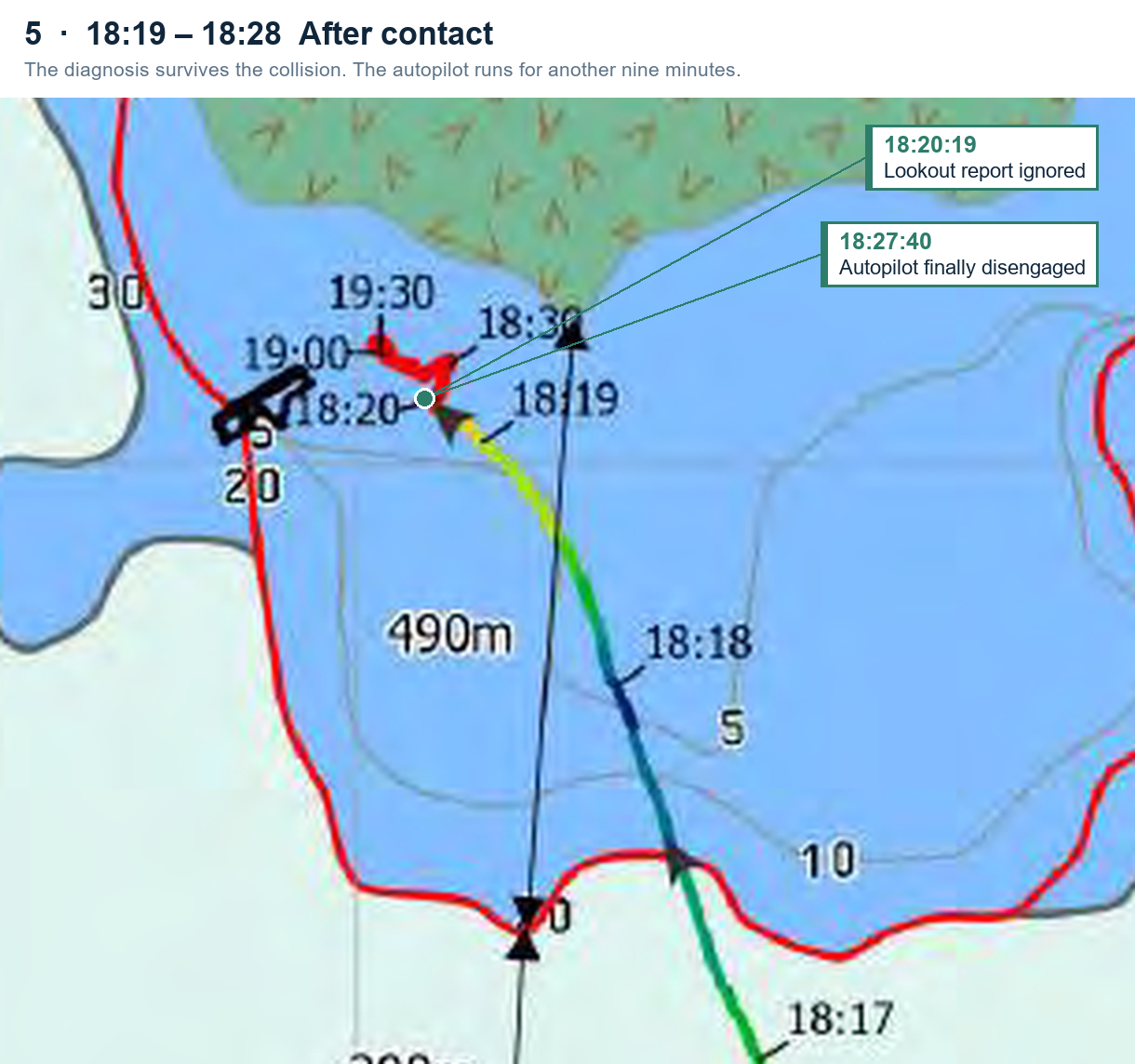
The ship travels a further 365 metres, striking repeatedly, and comes to rest at 18:19:30. Ninety-one seconds from afloat to stranded.
At 18:18:23 the engines are shut down, to defeat the thruster failure. All thrust falls to zero. The commanding officer, on the bridge for under a minute, says: so now we’ve got nothing.
It was a correct action inside a wrong frame, and it made things worse. This is the general shape of the problem. Once a diagnosis is adopted, competent people apply correct procedures with skill and speed, and every one of them is aimed at the wrong thing.
518:19:30 onwards, after contact
The diagnosis survives the collision.
At 18:20:19, with the ship aground, a lookout reports that he can see nothing astern that would prevent the thrusters working. Direct evidence against the thruster-failure theory, spoken aloud on the bridge, and it changes nothing.
The autopilot is not disengaged until 18:27:40. Nine minutes and forty-one seconds after the ship first struck the reef, and fourteen and a half minutes after it was engaged, somebody finally takes the ship in hand.
Seventy-five people were recovered alive. Manawanui is the first Royal New Zealand Navy vessel lost at sea since the Second World War.
What this case is actually about
The information was all there. The mode was knowable, the alarm sounded, the speed readout contradicted the astern order, the lookout said what he could see. The procedure existed and the crew had been trained on it.
What failed was not knowledge and not equipment. Between 18:14:47 and 18:15:57 a frame was adopted that made every subsequent piece of evidence legible as something else. After that, more information did not help, because information only means anything inside a frame.
Design could have closed the first gap without asking anything of anybody. A mode annunciator, or a message saying that a manual input had been rejected, and 18:13:08 never becomes an error at all.
Nothing on that bridge could close the second one.
All times and findings from the Court of Inquiry into the loss of HMNZS Manawanui, final report dated 31 March 2025. Paragraph references appear on the figures. Three officers face court martial arising from the loss; nothing here is a comment on those proceedings.
Where to send an independent analysis
A Court of Inquiry under the Armed Forces Discipline Act 1971 sits in private (s 200F), and the Manawanui inquiry closed when its final report was released in April 2025. There was never a public submission process, and there is no longer an inquiry to submit to. That does not mean there is nowhere to send a considered piece of outside analysis.
The Inspector-General of Defence is an independent statutory officer sitting outside the New Zealand Defence Force, established under the Inspector-General of Defence Act 2023. Section 8 gives the office two functions that matter here: to investigate incidents arising in the course of Defence Force activities and any subsequent acts or omissions of the Defence Force in relation to those incidents, and to assess and identify potential improvements to Defence Force policies and procedures. An argument about the adequacy of the method used to analyse an accident — and therefore about the completeness of the corrective actions drawn from it — falls squarely inside that second function.
The office states that any person may bring a matter to the Inspector-General's attention, in writing by post or email, or by phone or in person with written follow-up. If you are unsure whether something falls within scope, they invite you to contact them and ask. Anything sent should stay on system-level risk, method and organisational learning; court martial proceedings arising from the loss are before the court, and individual conduct is not the place for outside commentary.
Office of the Inspector-General of Defence
PO Box 609, Wellington 6140, New Zealand
Telephone: +64 4 470 0326
Email and enquiry details: igd.govt.nz/contact-us
The email address is obfuscated on the site against scrapers, so read it directly from that page. Check who currently holds the office before addressing correspondence by name.
Images and sources
Diagrams and photographs of HMNZS Manawanui are © New Zealand Defence Force, Crown copyright, reproduced here for the purposes of commentary and criticism, with the source cited on each image. No endorsement by the New Zealand Defence Force is implied. Analysis, annotation and any errors are the author’s own.
If you hold rights in any material here and would like it amended or removed, contact contact@yachtprep.com and I will act promptly.
About
YachtPrep Team
YachtPrep Team is a passionate developer and boating enthusiast with years of experience in web development and maritime activities. They love sharing knowledge and helping others navigate the waters of both coding and boating.