HMNZS Manawanui | 02 History
The ship was sixteen years old and had never had an accident
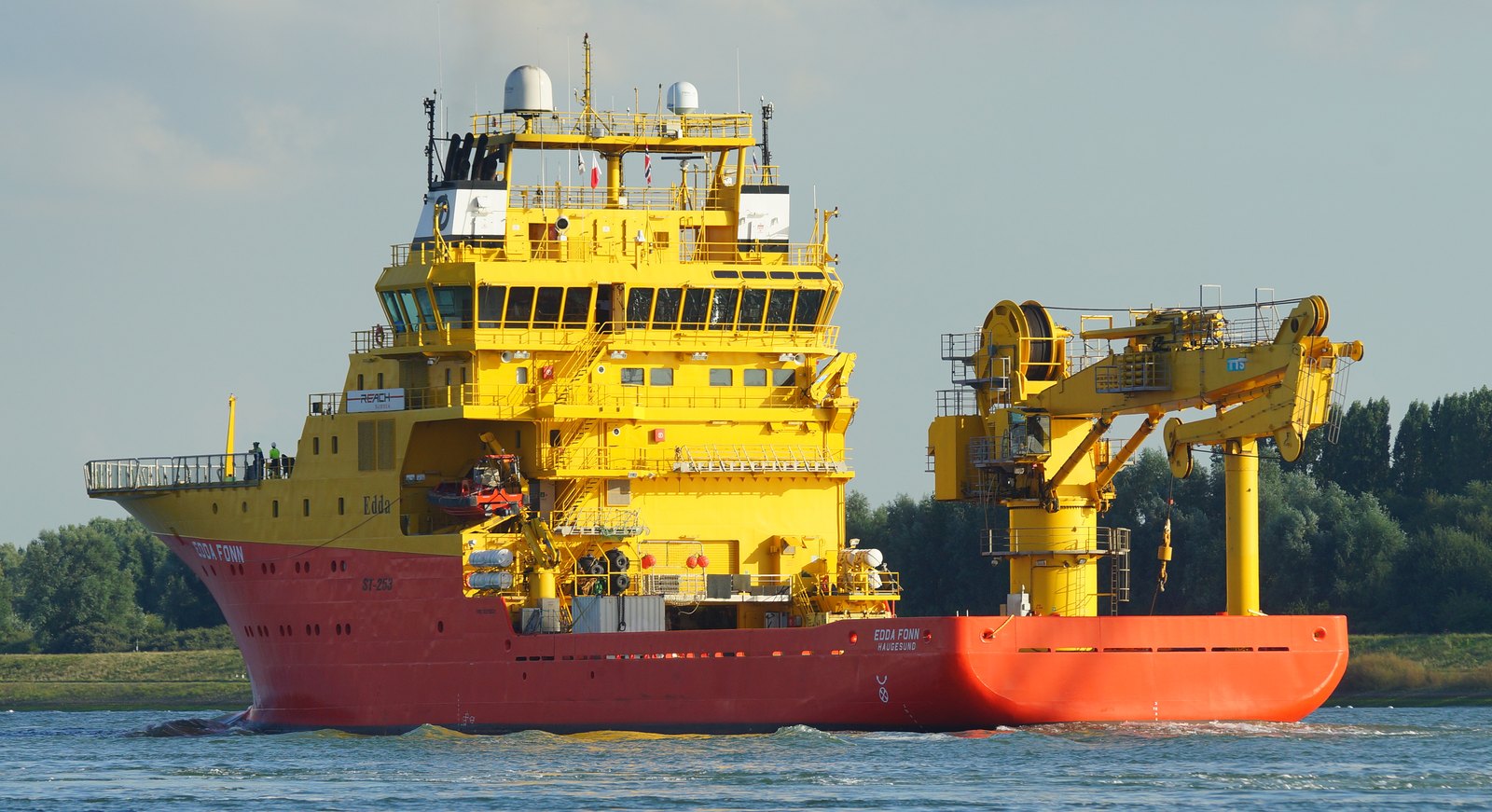
Edda Fonn at Maassluis, Rotterdam, 1 September 2016 — as she was before New Zealand bought her. Photograph by kees torn, licensed CC BY-SA 2.0, via Wikimedia Commons. Resized for the web; not otherwise modified.
Manawanui was not built for the Royal New Zealand Navy. She was built in 2003 at Myklebust Verft in Norway as Edda Fonn, a multi-role offshore support vessel for Østensjø Rederi of Haugesund, and she spent the next fifteen years doing inspection, maintenance and repair work, ROV support and survey, mostly in the North Sea. That is demanding water. She did it without losing herself on a reef.
In August 2018 Østensjø sold her. New Zealand had decommissioned the survey ship Resolution in 2012 and the old dive tender Manawanui in 2018, and had no replacement: funding earmarked for a purpose-built vessel had been diverted to cover cost overruns on the Anzac frigate upgrade. So the Ministry of Defence went shopping second-hand, reviewed something over 150 candidate offshore and subsea vessels, and picked this one. The reported figure was NZ$103 million covering purchase, modification and ancillary services, though the total project cost has been reported higher.
She was fitted with dive, ROV and hydrographic systems, went through Ørskov Yard in Frederikshavn, sailed forty-six days to New Zealand via Panama, and was commissioned at Devonport in June 2019 with the Prime Minister as her sponsor. Five years later she was on the reef.
What changed, and what didn't
The hull didn't change. The propulsion didn't change. Four diesel generators driving two aft azimuth pods and bow thrusters, the same arrangement that had worked in the North Sea for sixteen years.
The bridge didn't change either. That is the part worth sitting with.What changed was everything around the ship. A commercial offshore vessel operates under a safety management system built for that trade, with a crew who move between similar vessels, a class society auditing the system, a charterer auditing it again, and a manning structure where the person at the controls does that job full time. A naval vessel operates under a different regime entirely: a force generation pipeline, operational release through a Seaworthiness Board, platform endorsements, work-up, watchkeeping rotations that move officers between ships.
The Court of Inquiry found that pipeline had not been completed. Three elements of the force generation continuum were not done. The ship had never completed a work-up since entering service. Deviations were being mitigated by a future activity that never happened. Surveying, the task she was doing when she grounded, had not been operationally released or approved by the Seaworthiness Board, and the Court found the documentation on which roles had actually been released confusing.
And the Chief of Navy has named a standing problem with no commonality across the fleet. Which matters more than it sounds. In a fleet of identical ships, platform knowledge transfers with the officer. In a fleet assembled from different origins, including a Norwegian offshore vessel bought off the market, it does not. The Court found key bridge personnel had deficiencies in ship qualifications and platform endorsements, and that no authoritative document setting out minimum qualifications for this ship had been completed since her initial operational release.
So: a proven ship, in a system that had not finished absorbing her.
The controls, and why they look like that
Look at the bridge photograph NZDF released and you see three things they chose to label: the Autopilot System, Thruster 4, Aft PORT Azipod, and Thruster 5, Aft STBD Azipod.
Two things follow from that arrangement.
The autopilot control and the port pod lever are on the same console, within a single arm's span. Engaging the autopilot and steering by hand are the same reach and much the same gesture. Nothing about the physical act marks one of them as a change in who is driving the ship.
And the starboard pod is worked from a separate console, across the officer of the watch's position, perhaps a metre and a half away. Which has a sting in it. The Court's own evidence, in a footnote, is that in autopilot the starboard azimuth is dominant and does the manoeuvring while the port pod sits fore and aft. The pod the autopilot was actually driving on the run in to the reef was the one furthest from the autopilot switch.
None of this is a design defect in the ordinary sense. Read it as an offshore vessel and it makes sense: this is a ship that spends its working life switching between transit, joystick and dynamic positioning, with dedicated operators who do that and little else, often with a DP certificate and a logbook of hours to prove it. In that world, mode changes are frequent, expected, and the operator's whole attention is on the control problem. A bridge laid out for constant mode switching by a specialist is a reasonable bridge.
Read it as a naval bridge during close-quarters survey work, with an officer of the watch who also has the conn, the navigation, the survey task and the ship's safety, and the same layout asks something different. Mode becomes one item among many, and the one item with no announcement, no logging, and, as far as the report tells us, nothing that makes its state obvious to someone who is not looking for it.
I should be careful here. The layout diagram in the report marks controls, not displays, so nobody can say from the public evidence what mode indication existed on those consoles. What we do know is starker than that. The Court could not read the ship's control mode from the voyage data recorder at all. It had to deduce every mode change from thruster behaviour, using expert testimony. A formal inquiry, with the full data set and unlimited time, could only establish the ship's mode by inference.
The uncomfortable version
It would be neat to conclude that a commercial ship was pressed into naval service and the mismatch killed her. That is too easy, and probably wrong.
She had sixteen years without incident under commercial operation, with the same bridge. The difference was not the hardware. It was that the commercial system around that hardware had been fully worked out over years, and the naval system around it had not been finished. The controls were the same. The competence, the procedures, the training pipeline and the assurance that all three fitted together were the things still in progress.
Which is a more general point about buying capability second-hand. You get the steel immediately. Everything else has to be built, and it is the part nobody photographs at the commissioning ceremony.
Sources: Court of Inquiry into the loss of HMNZS Manawanui, final report 31 March 2025. Acquisition and history from Østensjø Rederi, the New Zealand Ministry of Defence and contemporary maritime press. Bridge photograph is an NZDF file image released with the interim report in November 2024. Readings of the console layout in the photograph are mine, matched against Figure 2 of the report; NZDF labelled the controls, not the consoles.
Images and sources
The photograph at the top of this page is by kees torn, licensed CC BY-SA 2.0 via Wikimedia Commons, and is credited beneath it. Diagrams and photographs of HMNZS Manawanui are © New Zealand Defence Force, Crown copyright, reproduced here for the purposes of commentary and criticism, with the source cited on each image. No endorsement by the New Zealand Defence Force is implied. Analysis, annotation and any errors are the author’s own.
If you hold rights in any material here and would like it amended or removed, contact contact@yachtprep.com and I will act promptly.
About
YachtPrep Team
YachtPrep Team is a passionate developer and boating enthusiast with years of experience in web development and maritime activities. They love sharing knowledge and helping others navigate the waters of both coding and boating.