HMNZS Manawanui | 08 Accountability
Removing three officers does not remove the cause
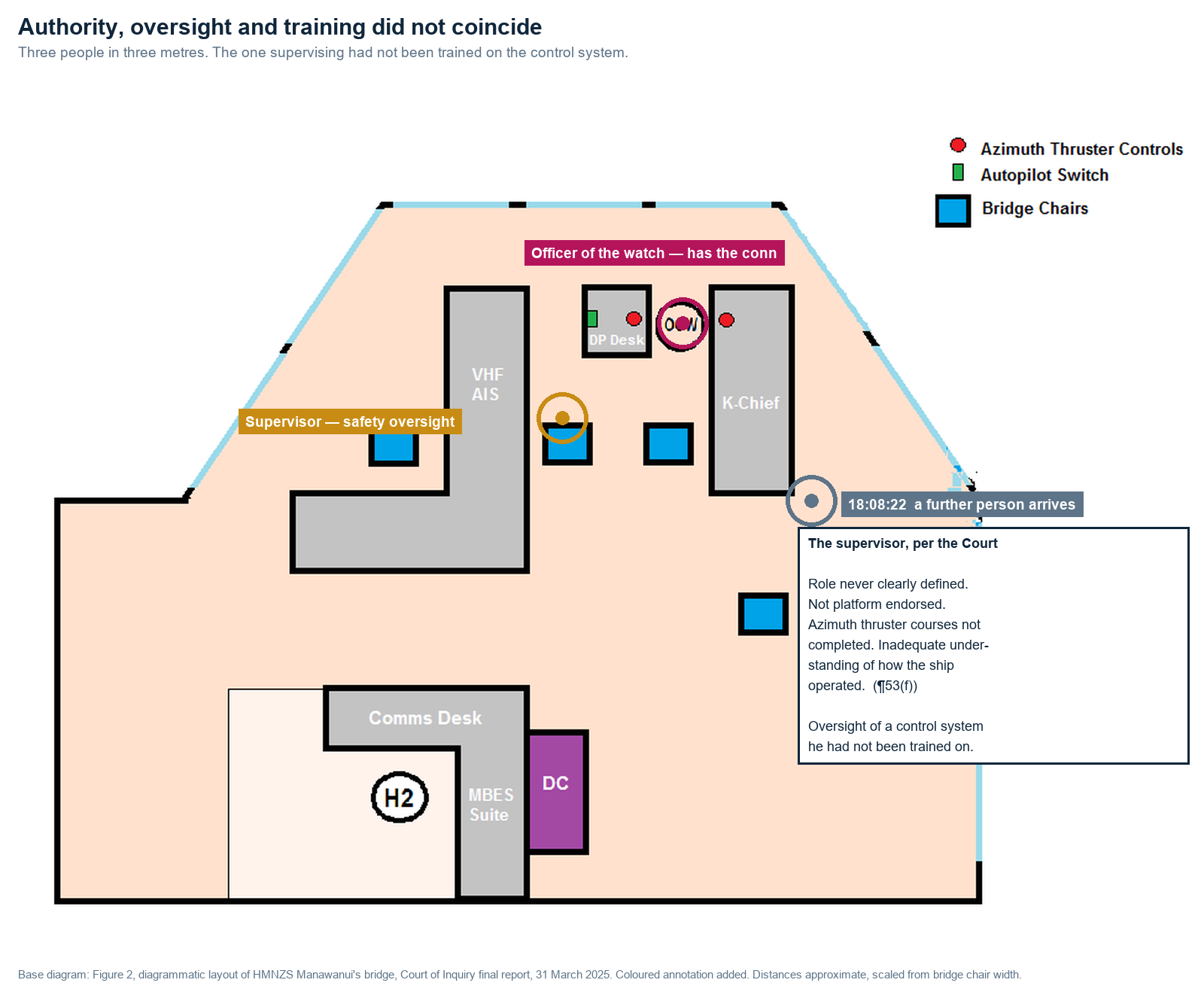
Authority, oversight and training did not coincide. Figure 2, diagrammatic layout of the bridge, from the Court of Inquiry into the loss of HMNZS Manawanui, final report 31 March 2025. © New Zealand Defence Force, Crown copyright. Reproduced for commentary and criticism. Annotation added by the author.
Introduction
Three officers of HMNZS Manawanui face court martial over the loss of the ship. Their careers are, in all likelihood, finished.
Here is the bigger question.
Does the removal of those three officers prevent the Royal New Zealand Navy losing another vessel in similar circumstances?
Reading the Court of Inquiry’s own findings, the answer is almost certainly no.
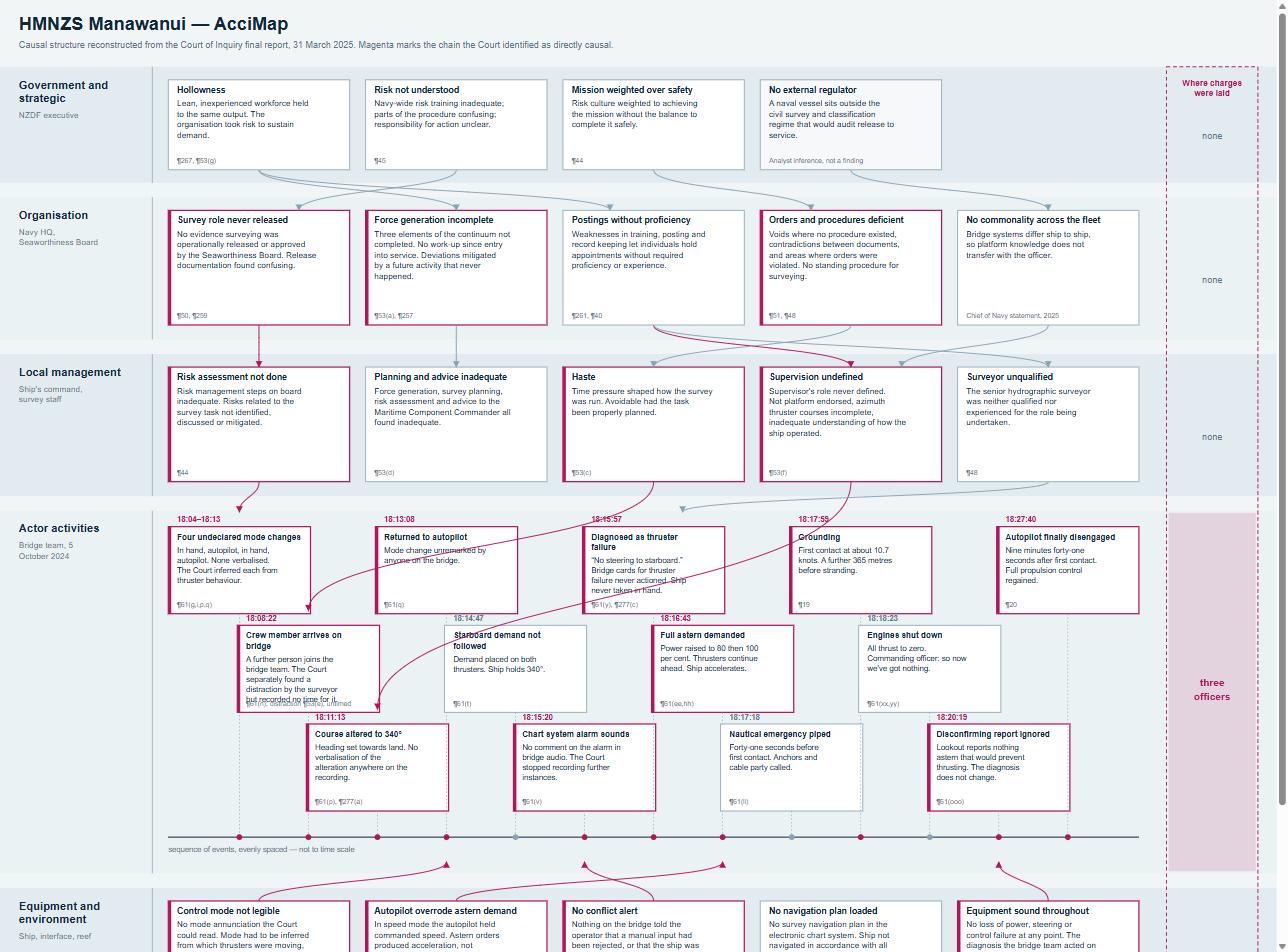
What the AcciMap shows
Drawing the inquiry’s findings as a causal structure rather than a list makes the shape visible. Causation runs vertically, down through the organisation, and arrives on the bridge as a set of conditions nobody on watch had chosen.
Officers in roles they were not qualified for. The Court found “weaknesses in the training, posting and record keeping systems which enabled individuals to hold appointments or posts without necessary levels of proficiency and /or experience in core skills, leadership and supervision” (¶261). The key bridge personnel “were found to have deficiencies in ship qualifications and platform endorsements” — and the reason is systemic: “an authoritative document detailing the minimum qualifications and experience requirements for the Ship had not been completed since the Ship’s initial operational release” (¶40).
Five years of ownership, and nobody had written down what you needed to know to work her.
Roles not defined. The supervisor’s role “was not clearly defined however it was commonly known to involve safety oversight of the survey task” (¶53(f)). Commonly known. Not written, not assigned, not assured.
Procedures with holes in them. Significant deficiencies across a wide range of orders, instructions and procedures, including “areas of no instructions or procedures which left a void to be managed”, and no standing procedure for the survey task at all (¶51, ¶48).
Risk management not done. On board, the risk management steps “were inadequate and risks related to the survey task were not sufficiently identified, discussed and mitigated”, with a culture “weighted heavily on achieving the mission without the necessary balance to ensure the mission was completed safely” — and the Court adds that this “can also be seen in some areas of the wider organisation” (¶44). Above that: “Risk management training within the Navy is inadequate and risk is not well understood” (¶45).
And the task should not have been running. No evidence surveying had been operationally released or approved by the Seaworthiness Board (¶50), on a ship that “had not completed a work-up since being introduced in to service” (¶53(a)).
Those officers were assigned duties they had not been prepared for, on a ship that had not been cleared for the task, under procedures that did not exist.
The detail that makes the comparison stark
Here is something I had assumed must be otherwise, and it is not.
Manawanui was conducting a survey half a mile from a charted reef. The report records that she was “at sea in a daily sea routine in a cruising watch state” (¶63).
A cruising watch state. The ordinary routine of a ship at sea. Not an augmented watch, not a special detail for close-quarters work.
And look at who that put on the bridge (¶64): the officer of the watch with charge of the ship; a supervisor in an undefined role who was not platform endorsed; a lookout who was also making pipes and acting as a spare hand; and a survey system operator reporting depths, whom the Court notes “did not have overall responsibility for the safe navigation of the Ship”.
There was no helmsman. Nobody on the wheel. Nobody whose job was steering.
Now set that beside the US Navy’s standing organisation for the same circumstances.
How another navy handles it
I went through OPNAVINST 3120.32D, the Standard Organization and Regulations Manual of the US Navy, looking for a rule prohibiting automatic steering near a hazard.
There isn’t one. The words autopilot and automatic steering do not appear in the document.
They do not need to, because of how the watch is manned:
4.19.3 MASTER HELMSMAN. The master helmsman holds a higher qualification than the helmsman and is utilized during all restricted maneuvering evolutions... They shall additionally be under the supervision of the helm safety officer.
4.19.6 HELM/AFT STEERING HELM SAFETY OFFICER... This officer ensures that steering control station personnel acknowledge and comply with all orders of the conning officer... and have no other duties while assigned.
There is also a lee helmsman on the engine order telegraph, and a manned after-steering watch ready to take steering control in the event of a casualty.
So for restricted manoeuvring a US warship has a higher-qualified person physically on the wheel, a commissioned officer supervising them whose only job is that, and a separate manned station ready to take over aft.
Manawanui, half a mile off a reef, had a cruising watch, no helmsman, and a supervisor who had not completed the azimuth thruster courses and was not endorsed for the platform.
Autopilot near a hazard does not need prohibiting in the US system, because a human being is holding the helm and answering spoken orders. And note what that architecture runs on: orders acknowledged and complied with, aloud. Which is precisely the callout discipline absent from Manawanui’s bridge, where four control mode changes in nine minutes went unannounced.
And the merchant rule she was exempt from
SOLAS Chapter V, Regulation 24 governs the use of heading and track control systems. In high traffic density, in restricted visibility, and in all other hazardous navigational situations, it must be possible to establish manual control immediately, and the officer of the watch must have available without delay the services of a qualified helmsperson, ready at all times to take over steering control.
Manawanui was not subject to it. SOLAS excludes warships, and New Zealand’s Maritime Transport Act 1994 removes the exemption into domestic law at section 4(1)(a): nothing in the Act or its rules applies to warships of the New Zealand Defence Force.
But had it applied, the first limb would arguably have been met — the autopilot switch was feet away and visible through its cover — and the second would not. There was no qualified helmsperson standing by. There was no helmsman at all.
So a merchant ship doing identical work in identical water would have been required to have a person ready on the wheel. The same hull, doing the same survey under charter, would have been regulated. Commissioned, she was not.
And navies wrote their own version anyway
The obvious objection is that exemption from a regulation is not exemption from the knowledge in it. That objection is correct, and the profession made it easy to act on.
In 2004 NATO convened navies and classification societies to build a naval equivalent of SOLAS. In December 2009 they published the Naval Ship Code as ANEP-77. Its own rationale is explicit: navies balance safety against military capability, and for many of them an acceptable level of safety is set as being equivalent to merchant ships under civil legislation. The Code is a goal-based standard with the same scope and an equivalent level of safety to SOLAS, and many navies now structure their regulatory authorities around its chapters.
Whether the RNZN has adopted ANEP-77 I have not been able to establish, and the Court does not mention it.
What the Court does say, at ¶48, is that there are “systems and processes in the maritime community that could have improved situational awareness related to surveying and helped prevent the loss of the Ship, which can be reviewed and considered in more depth by the RNZN.”
That is an inquiry saying, in institutional language, that the answers existed outside the Navy and nobody went and got them.
Where the consequences landed
Three officers charged. The officer of the watch, the supervising officer, and the commanding officer.
Above them, so far as has been reported: no resignations. The Minister of Defence remains in office. The Chief of Defence Force, appointed June 2024, remains in post. The Chief of Navy, appointed 27 August 2024 — six weeks before the grounding — remains in post.
That last appointment is worth a footnote rather than an accusation. Rear Admiral Garin Golding had been the Defence Force’s Maritime Component Commander since 2021, which is to say through the period the inquiry’s force generation, operational release and qualification findings cover. The Court found that advice to the Maritime Component Commander was among the things that was inadequate (¶53(d)).
I make no allegation about any individual. The point is structural, and it is this.
The three people removed are the three who were on the bridge. The culture, the personnel systems, the qualification regime and the release process that put them there are, so far as the public record shows, unchanged.
The question
Set the eight findings against the elements of a functioning quality system and there is a gap in every one: culture, governance, leadership, competence, procedures, risk management, readiness, resourcing.
So the question is not whether the bridge team erred. The inquiry found they did, and a procedure existed that would have worked.
The question is this. If the qualification document is still unwritten, the work-up still not completed, the supervisor’s role still commonly known rather than defined, the risk procedure still confusing and the hollowness still accepted — what is the guarantee that another naval asset and more skilled personnel will not also be lost?
Removing three officers removes three officers.
The next crew will inherit exactly the same conditions, on a different bridge, with a different hazard in front of them.
Quotations from the Court of Inquiry into the loss of HMNZS Manawanui, final report dated 31 March 2025, with paragraph references as given. US Navy provisions from OPNAVINST 3120.32D with change 1, 2012 edition. SOLAS Chapter V Regulation 24 as summarised from the IMO text and MCA guidance; statutory exemption from the Maritime Transport Act 1994, section 4(1)(a). Naval Ship Code details from the published rationale of the international naval safety association. Appointment dates from NZDF and New Zealand Government announcements. This is analysis of published findings and is not a comment on the court martial proceedings, which have not concluded.
About
YachtPrep Team
YachtPrep Team is a passionate developer and boating enthusiast with years of experience in web development and maritime activities. They love sharing knowledge and helping others navigate the waters of both coding and boating.