HMNZS Manawanui | 06 SOLAS
The rule that would have applied to any other ship
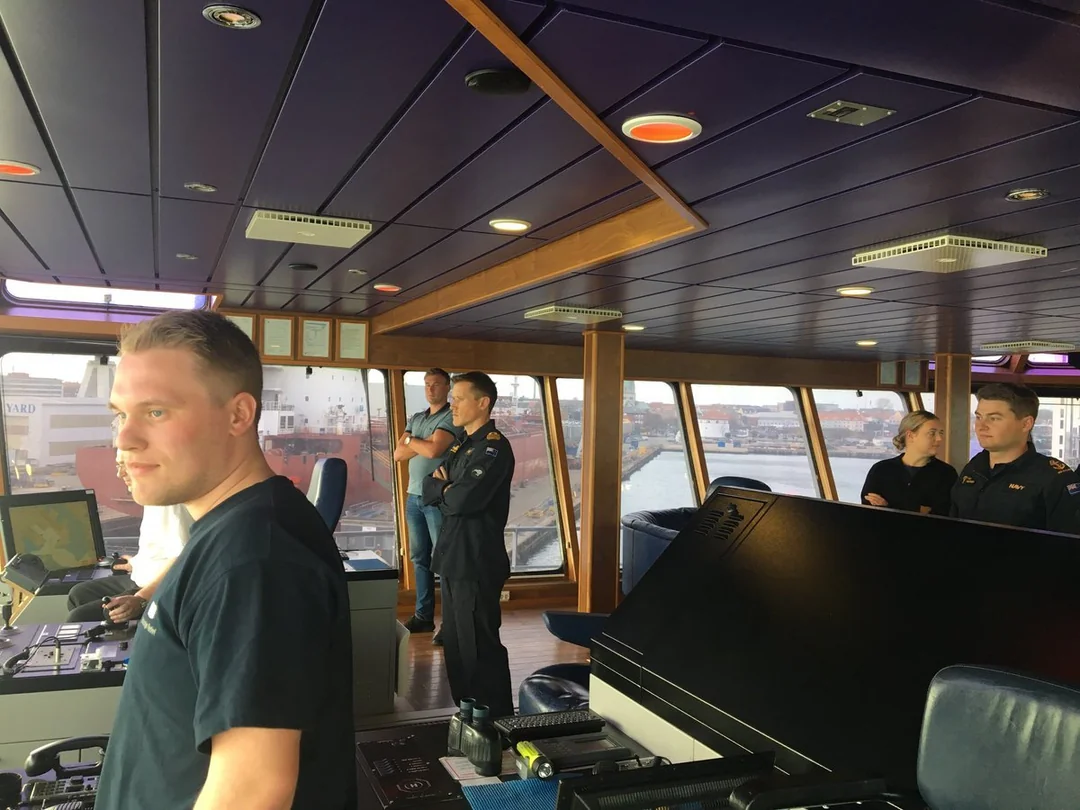
The bridge of MV Edda Fonn at Frederikshavn, Denmark, before her delivery voyage to New Zealand, April 2019 — the ship under the commercial regime, before the exemption applied. © New Zealand Defence Force, Crown copyright. Published by the Royal New Zealand Navy, 3 April 2019. Reproduced for commentary and criticism.
Introduction
Working through the loss of HMNZS Manawanui, one aspect made me very uncomfortable.
The Manawanui was surveying half a mile from a navigational hazard — a charted reef. The officer of the watch decided to point the ship towards this navigational hazard and engage the autopilot.
Let’s really think about this, set aside the mode confusion for a moment and look only at the setup.
A naval asset holding a collision course with a navigational hazard under autopilot control.
As a risk-managed procedure, that does not look defensible. It is not that it went wrong. It is that there appears to be no circumstance in which it was a good idea.
The Court of Inquiry found no rule against it. What it found instead were “areas of no instructions or procedures which left a void to be managed”, and separately that there were “no procedures for the [senior hydrographic surveyor] to follow in the planning and conduct of the activity” (¶51, ¶48).
So we went looking outside the report. If the Navy had no rule, does anybody?
What we found
There is a rule, and it is aimed squarely at this situation.
SOLAS Chapter V, Regulation 24 — Use of heading and/or track control systems.
It has two limbs. In areas of high traffic density, in conditions of restricted visibility, and in all other hazardous navigational situations where heading or track control systems are in use, it shall be possible to establish manual control of the ship’s steering immediately. And in those same circumstances, the officer of the watch shall have available without delay the services of a qualified helmsperson, ready at all times to take over steering control.
Note what it does and does not do.
It does not prohibit autopilot near a hazard. That surprised us. What it requires is that you can revert instantly, and that a qualified person is standing by to take the wheel. The decision to engage or disengage is left to the master’s judgement — the MCA’s guidance frames it as the master considering whether to disengage in restricted waters.
So the regulation governs revertibility, not use. Which is a weaker instrument than it first appears, and we will come back to that.
Manawanui was not subject to it
Before going further: Regulation 24 did not apply to this ship, and nothing that follows is an allegation that anyone broke the law.
The chain is short and it is worth setting out, because it explains a great deal about the rest of the case.
SOLAS excludes warships. Chapter I, Regulation 3 exempts ships of war and troopships from the convention.
New Zealand implements its IMO obligations through the Maritime Transport Act 1994, whose long title includes enabling the implementation of New Zealand’s obligations under international maritime agreements.
And section 4(1)(a) of that Act removes warships from all of it:
Except as otherwise provided in this Act, or in any regulations or rules made under this Act, nothing in this Act, or any regulations or rules made under this Act, shall apply to — (a) warships of the New Zealand Defence Force
Paragraph (f) extends the exemption to the master and crew.
Was a hydrographic ship a warship? Yes. The definition follows UNCLOS Article 29 and is about status, not armament: a ship belonging to the armed forces of a State, bearing the external marks distinguishing its nationality, under the command of a duly commissioned officer whose name appears in the appropriate service list, and crewed by people subject to regular armed forces discipline. Manawanui met every limb. Nothing in the definition mentions weapons.
The Act does reach NZDF warships in places, but the carve-ins are almost all environmental — sections 344 to 352, 361 and 368, plus the marine pollution provisions at section 223. The statute catches a warship for discharging oil. It does not reach how she is navigated.
So: no SOLAS, no maritime rules, no Maritime New Zealand jurisdiction over her navigation.
Had it applied, would she have complied?
This is a hypothetical and we offer it as one. But it is a useful test, because it shows what an external standard would have caught and what it would have missed.
Was Regulation 24 engaged at all? Almost certainly. The regulation bites in high traffic density, restricted visibility, and all other hazardous navigational situations. A survey conducted half a mile from a charted reef, at survey speed, in 20 to 25 knots of wind and a high sea state 3, is a hazardous navigational situation on any ordinary reading. So the heightened requirements would have applied from the moment the task began — not from the moment trouble started.
Limb one — could manual control be established immediately? On the face of it, yes. The autopilot switch was on the DP desk, feet from the officer at the controls. The Court notes that “visual inspection of the autopilot switch through its covering Perspex box would also have indicated whether the Ship was in autopilot.” Nothing mechanical prevented an immediate switch to manual.
So on this limb, compliance. And the ship went on the reef anyway.
Limb two — a qualified helmsperson available without delay? This is where it fails, and the Court’s own findings are the evidence.
The supervisor “had not completed all of the azimuth thruster training courses and had not been platform endorsed for the ship”, and had “inadequate situational awareness and understanding of how the ship operated” (¶53(f)).
More broadly, the key bridge personnel “were found to have deficiencies in ship qualifications and platform endorsements”, and — this is the part that makes it systemic rather than individual — “an authoritative document detailing the minimum qualifications and experience requirements for the Ship had not been completed since the Ship’s initial operational release” (¶40).
If nobody had completed the platform qualification, and no document even defined what that qualification was, then there was no qualified person standing ready to take over steering control. Not as a failure of rostering on the night, but because the Navy had not established what qualified meant for this ship in five years of ownership.
Our reading: compliant on revertibility, non-compliant on standby competence.
What that tells us, and what it doesn’t
Two conclusions, and the second is more important.
First, an external standard would have caught something real. Regulation 24 would have forced the question of who on that bridge was qualified to take the ship in hand, and the answer would have been uncomfortable. That is a rule doing its job.
Second, and more soberingly: compliance would not have prevented this.
A qualified helmsman standing ready is no use when nobody realises the autopilot is steering. The regulation guards against being unable to revert. Manawanui’s failure was being unaware that reversion was needed. Those are different failure modes, and no rule we have found anywhere addresses the second.
Which is the pattern this series keeps running into. The instruments we have are aimed at capability — can you do the thing if you decide to. They are not aimed at the noticing that precedes the decision.
The bigger point about the exemption
There is a consequence of section 4 that deserves its own weight.
Manawanui was built in 2003 as the offshore support vessel Edda Fonn. For sixteen years she worked the North Sea under the full commercial regime — SOLAS, classification society survey, flag state inspection, charterer audit. Four independent external layers, each entitled to look at her and say no.
New Zealand bought her in 2018. At the moment she was commissioned, every one of those layers fell away. Not because anybody assessed them as unnecessary. Because section 4(1)(a) says warships are out.
And note how the exemption works: it follows the employment, not the hull. The Act excludes NZDF ships from the definition where they operate for the time being for a commercial purpose. So the same survey, on the same seabed, in the same ship, is regulated when done under charter and unregulated when done under commission.
The steel did not change. The oversight went to nothing.
Which makes the internal system load-bearing in a way it is not on a commercial vessel. When the Seaworthiness Board is the only body that can declare a ship fit for a task, and the Court found “no evidence that surveying had been operationally released or had been approved by the SwB” (¶50), there is nothing behind that gap. No class surveyor. No port state control. No flag state inspector.
The self-governance was the entire assurance layer. And on this task, it did not operate.
Quotations from the Court of Inquiry into the loss of HMNZS Manawanui, final report dated 31 March 2025, with paragraph references as given. Statutory text from the Maritime Transport Act 1994, section 4(1)(a). SOLAS Chapter V Regulation 24 as summarised from the IMO text and MCA guidance. The compliance assessment above is hypothetical — Regulation 24 did not apply to this vessel — and is offered as analysis, not as an allegation. This is not a comment on the court martial proceedings arising from the loss.
About
YachtPrep Team
YachtPrep Team is a passionate developer and boating enthusiast with years of experience in web development and maritime activities. They love sharing knowledge and helping others navigate the waters of both coding and boating.